

Roadless Area Conservation Rule Brings $24B in Benefits
On this page: Key findings | Download the factsheet | Watch a webinar | Explore state-by-state data | Get in touch
The 2001 Roadless Area Conservation Rule conserves a total of 58.5 million acres of largely undeveloped, road-free national forest lands—called inventoried roadless areas—from road construction and timber harvesting.
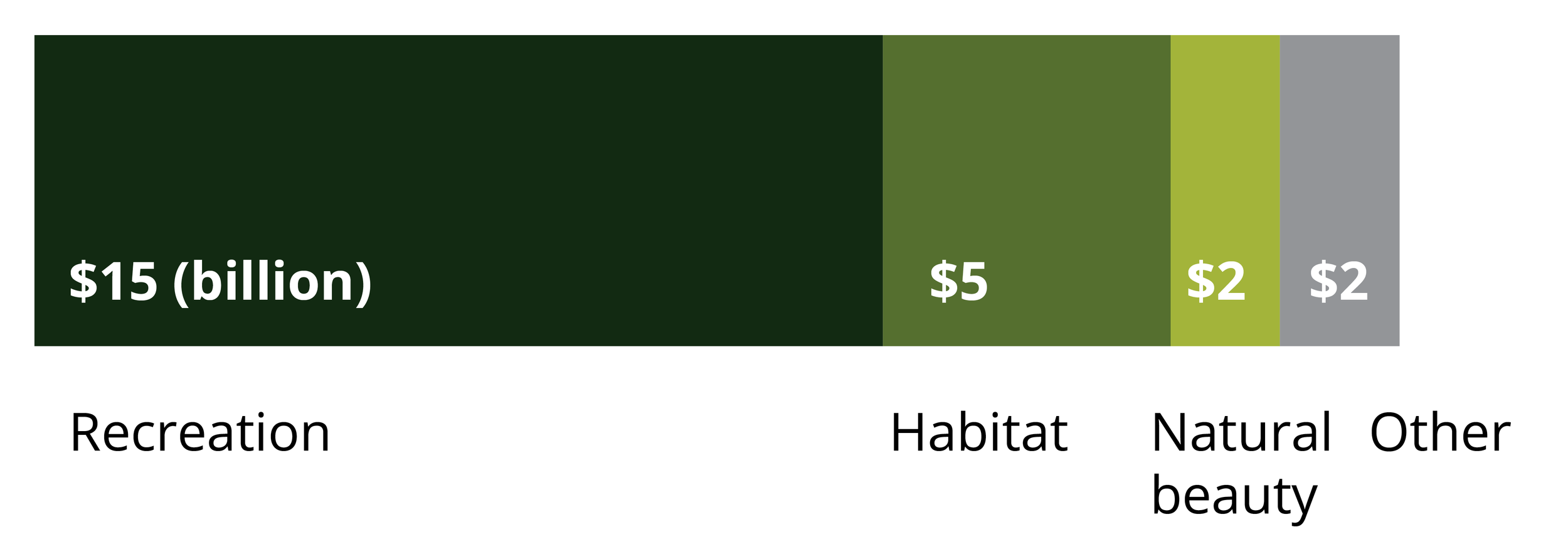
Through an initial economic analysis of ecosystem services, Earth Economics found that 30 million of these acres across the contiguous United States generate $24 billion in benefits every year.
Organizations can use this high‑level, national analysis to translate the benefits of roadless areas into clear economic terms to raise awareness and inform decision makers about the benefits of these lands.
Ecosystem Services of Greatest Value
Looking for state-specific analysis or want a more detailed regional analysis? Explore our dashboard below, or get in touch to see if a custom evaluation is right for your needs. Email Glen Delaney at gdelaney@eartheconomics.org.

Download the factsheet
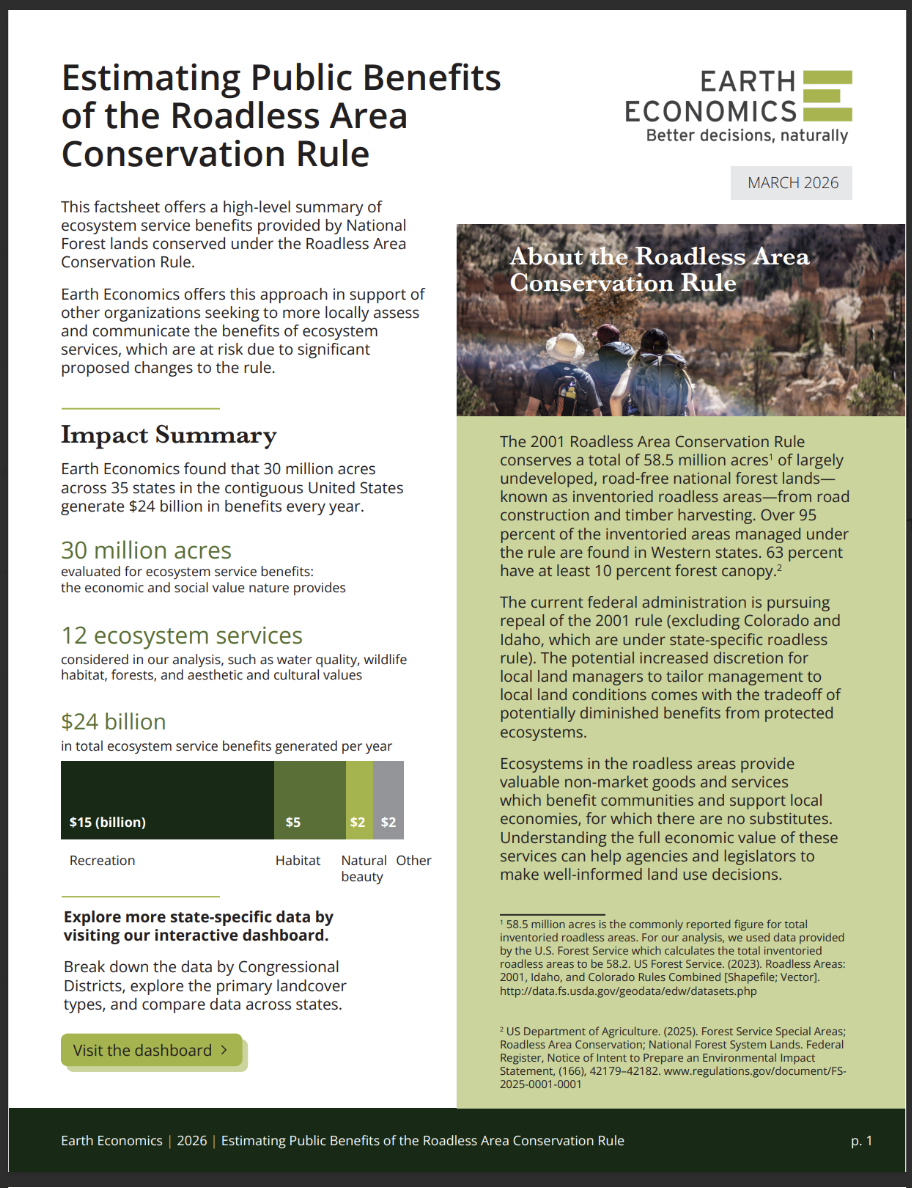
We have produced a printable and digitally sharable factsheet you can use to highlight the economic value of roadless areas with others.
Please fill out the form below to access the factsheet.
Your information will be kept confidential, and we will never share or sell it to third parties.
Dive into the analysis
Hear Earth Economics staff explain how we approached our analysis, what factors we considered, and what ways you can leverage this analysis for raising awareness of the ecosystem services of roadless areas. Thanks to The Wilderness Society for hosting this webinar.
Explore state-by-state data
Break down the national-level data by Congressional Districts, explore the primary landcover types, and compare data across states through this interactive dashboard.
Please Note: The congressional district- and state-level results are high-level, order-of-magnitude estimates and are best suited for illustrative purposes and general advocacy, not as precise figures for formal policy testimony or funding justification. They are intended to demonstrate the scale of ecosystem service benefits of roadless areas as well as the type of analysis that is possible in support of reducing risk and extending the benefits of nature.
For organizations seeking more detailed or place‑specific results, Earth Economics can apply this approach using local data to develop more precise analyses.
Trouble with the interaction? View dashboard in separate window →
Apply this analysis at the state-level
This analysis is designed to help conservation organizations and public agencies understand the impact of changes to Roadless Rule policies in clear economic terms. By putting dollar values on the benefits provided by these ecosystem services, we make it easy to understand what’s at stake and use defensible research to educate decision makers.
This assessment is intentionally high level, offering a consistent, nationwide view of ecosystem service benefits. Organizations seeking more detailed insight—such as state‑specific estimates or place‑based analyses—can work with Earth Economics to develop tailored studies that incorporate local data, increasing the precision and relevance of results.
Get in touch to see how our analysis may be right for you. Send us a note at info@eartheconomics.org.